

Volleyball puts a lot of stress on your ankles. You jump, land, change direction, stop suddenly, and sometimes land very close to another player’s foot. A single awkward landing can be enough to roll an ankle.
I learned pretty quickly that ankle support is something you notice most after a bad landing. A good brace does not make you invincible, but it can give your ankle additional support when you are playing hard, especially if you have sprained it before.
If you are looking for the best ankle brace for volleyball, you have plenty of options. Some braces are thin and flexible, while others provide much stronger lateral support. The right choice depends on your injury history, playing position, shoe fit, and how much movement you want to maintain.
In this guide, I have covered 8 of the best ankle braces for volleyball, including lace-up, strap-based, semi-rigid, and rigid-support designs. I will also explain what to look for before buying one and how to choose the right level of support.
Before getting into the details, here is a quick look at the eight braces.
Top Ankle Braces For Volleyball — Comparison Table
1. McDavid 195 Ankle Brace With Straps
Best overall ankle brace for volleyball
Approximate U.S. price: $46.99
Support level: Moderate
Best suited to: Regular volleyball, prevention and mild instability
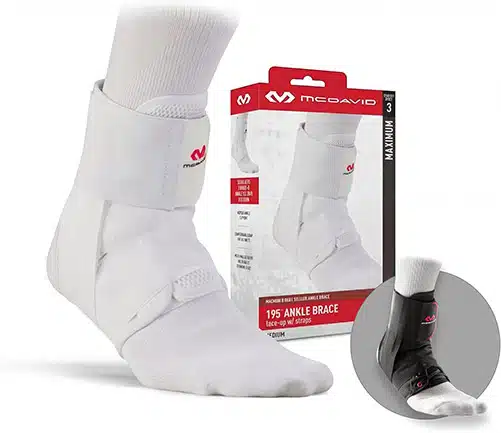
If someone asked me to recommend one ankle brace without knowing anything else about their playing style, the McDavid 195 would probably be the first one I would mention.
The reason is fairly simple. It gives you adjustable support without turning your ankle into a bulky package of plastic and padding.
The McDavid 195 uses a figure-6 strapping system. McDavid describes this system as providing support similar to an athletic tape wrap while allowing the player to adjust the brace. The manufacturer lists the brace for prevention and recovery from common ankle sprains and ankle instability.
That is useful for volleyball.
A lot of players already know what ankle taping feels like. The problem is that taping takes time, and getting the same result every time depends on how well the tape is applied. With the McDavid 195, you put it on, adjust the straps and get on with your practice.
I also like the fact that it does not try to do too much.
A volleyball player needs to move. You are constantly shuffling, changing direction, jumping and landing. A brace that feels like it is fighting every movement can become more annoying than helpful.
The McDavid 195 offers a good middle ground.
It is especially worth considering if you have rolled your ankle before but do not need the strongest possible brace.
One thing I would not skip is the shoe test. Put on the brace and wear your normal volleyball shoes. Walk around, jump a few times and move from side to side. Your shoe should still feel secure.
If the brace makes the shoe too tight, that is a problem you want to discover before match day.
The good part – the straps give you plenty of control over the fit, and the design is practical for regular use.
The downside – if your ankle has serious or repeated instability, you may want something with more structure.
My verdict
For the average volleyball player looking for additional ankle support, the McDavid 195 is the easiest recommendation on this list.
Rating: 9/10
Best ankle brace for chronic ankle instability
Approximate U.S. price: $75
Support level: Strong
Best suited to: Repeated sprains and chronic instability
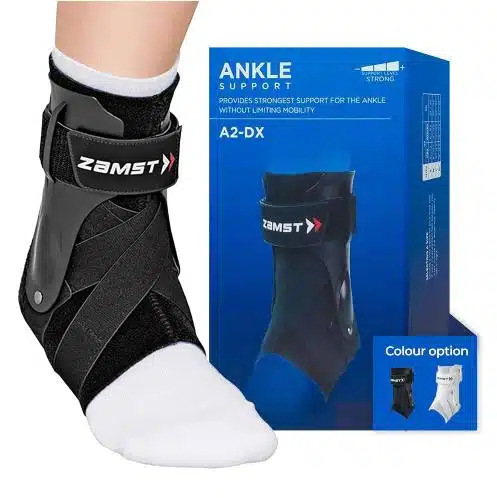
The Zamst A2-DX is a different kind of ankle brace.
You can tell as soon as you look at it that it is designed for players who need more support. It has stabilizing guards and dual X-straps, and Zamst specifically lists chronic ankle instability and high ankle sprains among the conditions for which the A2-DX is intended.
For someone who has had an ankle roll once several years ago, this may feel like overkill.
For a player whose ankle keeps giving way, that is a different story.
Repeated ankle sprains can become frustrating. You start thinking about your ankle every time you jump near the net. That is exactly where a stronger brace can make sense as part of a broader recovery and prevention plan.
The A2-DX comes in separate left and right versions, which is another nice touch. Zamst has also provided specific sizing based on shoe size.
According to Zamst’s current U.S. sizing information, the A2-DX covers adult men’s sizes from 5 through 16.5 and women’s sizes from 6 through 17.5, depending on the brace size.
Still, I would not order this brace based on shoe size alone without checking the current manufacturer’s sizing chart.
There is also a trade-off.
The extra support means extra material around your ankle. Some players will have no issue with that. Others will immediately notice the difference inside their volleyball shoes.
That is why I would strongly recommend wearing the brace at practice before using it in a tournament.
The good part – it provides a high level of ankle support and is specifically designed with instability in mind.
The downside – it is more substantial and costs more than simpler braces.
My verdict
If your biggest concern is repeated ankle rolling, the A2-DX is one of the first braces I would investigate.
Rating: 9.2/10
3. Med Spec ASO Ankle Stabilizer
Best value for volleyball players
Price: Varies
Support level: Moderate to strong
Best suited to: Everyday support and players who prefer lace-up braces
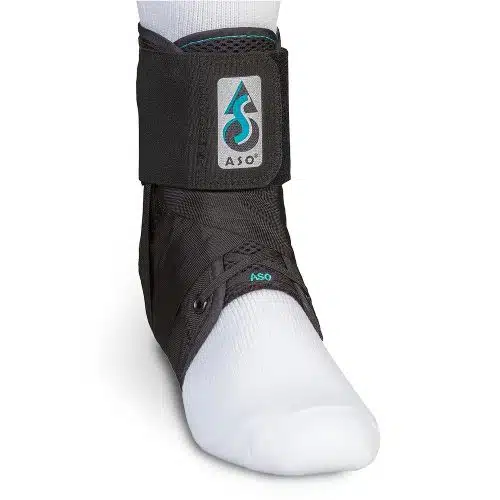
The Med Spec ASO is the kind of ankle brace that does not need a complicated design to do its job.
It uses laces and stabilizing straps that wrap around the ankle in a figure-eight pattern. Med Spec says the brace is intended for inversion and eversion ankle sprains, as well as medial and lateral ankle instability.
For volleyball, that design makes a lot of sense.
You get a snug fit around the foot, and you can adjust the straps depending on how the brace feels that day.
That last part can be more useful than it sounds.
Your feet may feel different after a long practice than they do at the beginning of the day. If your ankle is slightly swollen after an injury, you may also appreciate having an adjustable brace rather than one with a fixed fit.
The ASO also does not use a large rigid shell.
That makes it easier to pair with many indoor court shoes.
There is a small learning curve, though. Lace-up braces take a little longer to put on, and you need to get the strap pattern right. Once you have done it a few times, it becomes part of your normal routine.
I would put this near the top of the list for players who want traditional ankle support without paying premium prices.
The good part – it has a simple, adjustable design and offers a good level of support for regular volleyball use.
The downside – it takes longer to put on than a basic one-strap brace.
My verdict
A very sensible choice if you want a traditional lace-up volleyball ankle brace without spending too much.
Rating: 9/10
Also read: How to Wear Volleyball Knee Pads in a Correct Way
4. Ultra Zoom Hinged Ankle Brace
Best hinged ankle brace for volleyball
Approximate U.S. price: $59.95
Support level: Strong
Best suited to: Players who want stronger support with controlled movement
The Ultra Zoom is worth looking at if you do not like the idea of a traditional lace-up brace but still want a serious level of support.
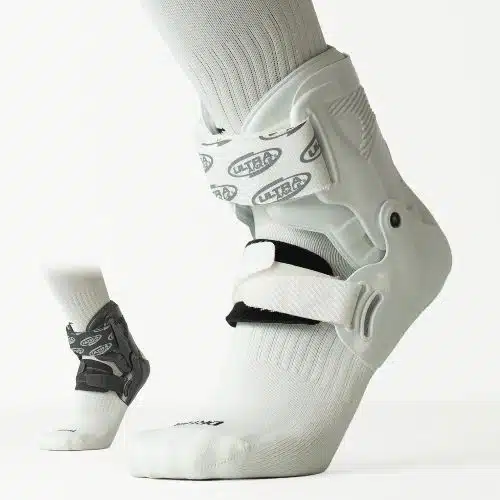
It uses a soft-shell design with a hinge. According to Ultra Ankle, the brace is intended to provide strong stability while still allowing protected movement.
That combination is interesting for volleyball.
You do not want an ankle brace that prevents normal movement. At the same time, someone dealing with instability may not feel comfortable wearing a very flexible support.
The hinge provides a controlled range of movement, while the surrounding structure helps limit unwanted rolling.
The brace is also designed to mold to the user’s foot and ankle through body heat.
I would put this model into the “try it before you commit” category.
Some players love the feeling of a hinged brace because it feels secure. Others prefer the lighter feel of a lace-up model.
Neither reaction is wrong. Your ankle and your volleyball shoes are going to determine which one feels better.
Ultra Ankle lists sizing by ankle circumference rather than simply using shoe size. That is another reason to measure carefully before ordering.
The good part – the hinged design offers strong support without relying entirely on a rigid shell.
The downside – it is bulkier than some traditional braces and may take time to feel natural.
My verdict
A good option for volleyball players who specifically want hinged ankle support.
Rating: 8.8/10
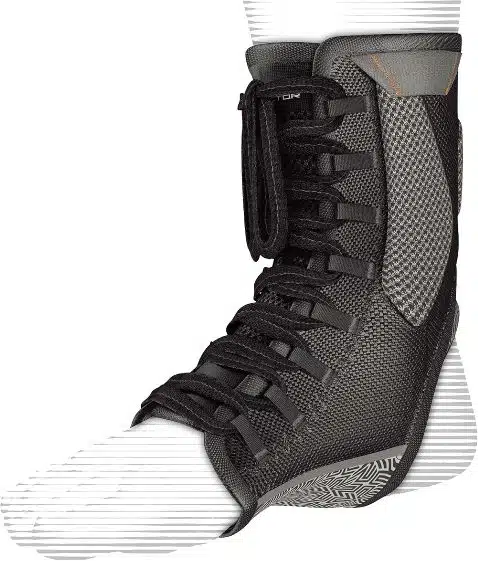
5. Shock Doctor 849 Ultra Gel Lace Ankle Support
Best for cushioning and support
Approximate U.S. price: $41.99
Support level: Strong
Best suited to: Players who want extra cushioning
If comfort is high on your list, the Shock Doctor Ultra Gel Lace deserves a look.
The brace uses a lace-up design and adds gel cushioning around the ankle. Shock Doctor currently lists it as a Level 3 maximum-support product and says it is intended for injury prevention, recovery and ankle instability.
That combination is useful when you are spending several hours in a gym.
Volleyball tournaments can be long. You might warm up, play a match, sit for a while and then get called back onto the court. A brace that feels fine for 30 minutes can feel very different after several hours.
The gel padding is intended to make the brace more comfortable.
It also has an anatomical footbed with a silicone grip designed to help keep the foot from sliding around inside the brace.
There is one thing to watch.
Padding takes up space.
If your volleyball shoes already fit very closely, adding a cushioned brace may make them feel tighter. This is not necessarily a problem, but it is something to test before buying.
The good part – the cushioning is appealing for players who dislike hard or uncomfortable ankle supports.
The downside – it may take up more room inside a snug volleyball shoe.
My verdict
A good choice when you want a strong brace but do not want to give up cushioning.
Rating: 8.7/10
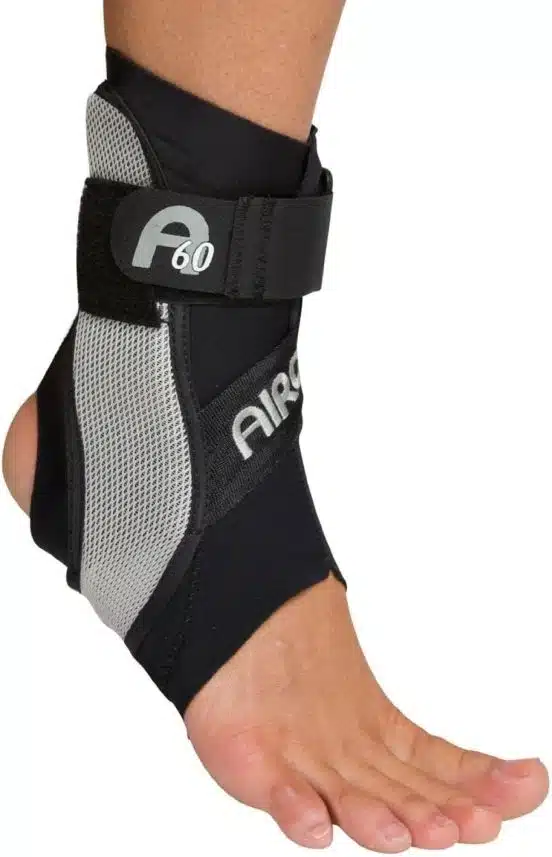
6. Aircast A60 Ankle Support
Best lightweight ankle support
Price: Varies
Support level: Moderate
Best suited to: Prevention and mild ankle instability
Some players simply do not like bulky ankle braces.
If that sounds like you, the Aircast A60 is worth considering.
The A60 uses a stabilizer positioned at a 60-degree angle. Enovis says the design is intended to help guard against ankle sprains and rollover and lists it for chronic mild instability and prophylactic use.
The design is fairly simple.
There is no long series of straps to figure out. There is no large hinged shell around the ankle.
For someone who wants to put on an ankle support quickly before practice, that simplicity can be a real advantage.
The A60 is available in separate left and right versions.
It is also designed to fit into athletic footwear, which is obviously important for volleyball.
I would not choose this model for a player who needs the highest possible level of support. But for someone who has mild instability or simply wants additional protection during play, it makes sense.
The good part – lightweight, simple and easy to use.
The downside – it may not provide enough support for players with serious or repeated instability.
My verdict
A good choice if you want a simple ankle support that does not feel overly bulky.
Rating: 8.5/10
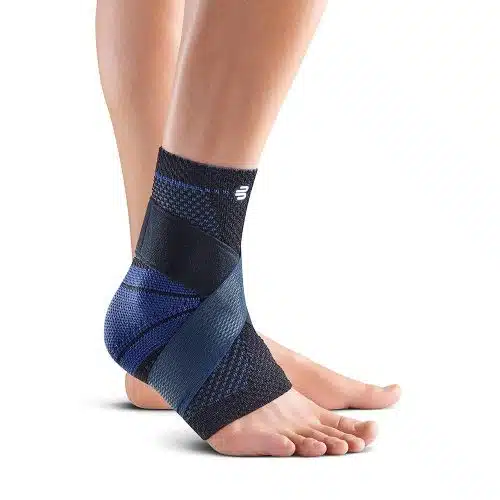
7. Bauerfeind MalleoTrain S
Best premium ankle brace for volleyball
Approximate U.S. price: $101.92
Support level: Moderate
Best suited to: Players who care about comfort and long-term wear
The Bauerfeind MalleoTrain S is the most expensive option on this list, and I would not recommend it simply because it costs more.
Its appeal is different.
The brace uses a knitted compression design with an adjustable figure-eight strap system. Bauerfeind says it is designed to stabilize the ankle while allowing movement and lists it for ankle sprains, ligament instability and chronic or post-traumatic irritation.
The material is breathable and designed for active use.
That can be useful if you are the type of player who wears an ankle brace throughout long practices or tournament days.
I also like the fact that the brace does not look or feel like a large protective shell.
It is closer to the feeling of wearing a supportive piece of sports clothing.
Of course, there is a catch.
The price is much higher than several other braces here. If you only want basic ankle support, you can spend considerably less.
The MalleoTrain S makes more sense if you already know you want an ankle brace and comfort is important enough to justify spending extra.
The good part – premium materials, breathable construction and a comfortable compression-based design.
The downside – the price is high compared with most alternatives.
My verdict
A strong premium option for players who plan to wear ankle support regularly and place comfort high on their list.
Rating: 8.8/10
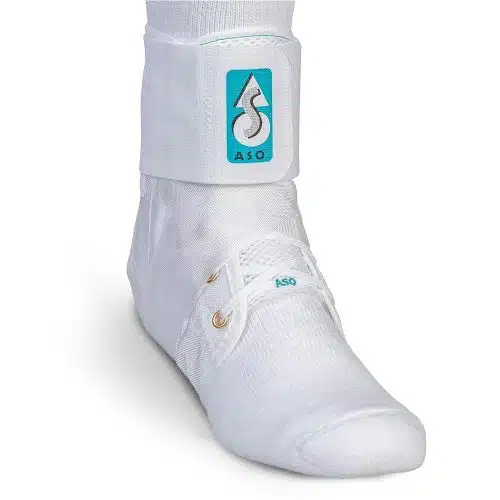
8. ASO Flex-Hinge Ankle Stabilizer
Best for stronger support with a hinge
Price: Varies
Support level: Strong
Best suited to: Instability and return-to-play support
The ASO Flex-Hinge takes the familiar ASO design and adds an internal hinge.
If you like the idea of a lace-up brace but need something more supportive, this is where the Flex-Hinge becomes interesting.
Med Spec lists the brace for inversion and eversion ankle sprains, high ankle sprains and several forms of ankle instability.
The figure-eight strap system helps hold the ankle in place, while the hinge allows controlled movement.
That can be useful for a volleyball player who is coming back from an injury and needs more support than a basic sleeve can provide.
However, I would be more careful with this type of brace after an injury.
If you are still recovering, the important question is not simply whether you can put on a brace and play.
You need to know whether your ankle is actually ready for jumping, landing and quick changes of direction.
A brace can be part of the plan, but it should not be the plan by itself.
The good part – strong support with a hinged design and the familiar ASO strap system.
The downside – it is more substantial and may take some time to get used to.
My verdict
A useful option for players who need stronger support and prefer a hinged design.
Rating: 8.7/10
How to Choose the Right Ankle Brace for Volleyball
Start With Your Injury History
This is the first thing I would consider.
If you have never had an ankle injury, you may only want light or moderate support.
If you have had several sprains, you may need a brace that provides more control.
If you are recovering from a serious injury, talk to a healthcare professional before deciding which brace to wear on the court.
Think About Your Volleyball Shoes
A brace can be comfortable on its own and still feel terrible inside your shoe.
This happens because volleyball shoes are generally designed to fit closely around the foot.
A bulky brace can change that fit.
Before playing a full match, wear your brace with your volleyball shoes and walk around. Then try some easy volleyball movements.
If your toes feel cramped or your heel no longer sits properly, stop and reassess.
Check How the Brace Closes
Lace-up braces take a little longer to put on but give you a lot of control.
Strap-based braces can be faster.
A single-strap design is even easier.
There is no universally best closure. It depends on how much adjustment you want and how much time you are willing to spend getting ready.
Measure Your Ankle
This is one step that is easy to skip.
Don’t.
Different brands use different sizing systems.
Some use shoe size. Others use ankle circumference.
For example, the Ultra Zoom uses ankle circumference, while Zamst provides shoe-size-based sizing for the A2-DX.
Always check the current manufacturer’s chart before ordering.
A brace that is the wrong size can be uncomfortable and may not provide the support you expected.
Do Ankle Braces Actually Prevent Volleyball Injuries?
The evidence is encouraging, but it needs to be understood correctly.
A systematic review and meta-analysis of athletes found that ankle bracing reduced the risk of acute ankle injuries. For secondary prevention, meaning athletes who had already experienced an injury, the evidence was stronger than for primary prevention.
Another systematic review that examined bracing and balance training found that athletes who wore braces had fewer ankle sprains, with the analysis estimating a 64% reduction in risk compared with controls. Balance training also reduced ankle sprain risk.
There is also volleyball-specific research.
One study of high school volleyball players examined more than 900 players who wore ankle braces and a smaller control group. The overall results were mixed, with some benefits depending on previous injury history and brace type.
Another study involving collegiate female volleyball players reported a significantly lower ankle injury rate when a double-upright brace was used.
So, the practical conclusion is simple:
An ankle brace can reduce injury risk, but the brace you choose should match your injury history, ankle stability and playing needs.
How Much Should You Spend on a Volleyball Ankle Brace?
You don’t have to spend $100 to get decent ankle support.
Several options on this list cost less than $60.
The McDavid 195 is currently listed around $46.99. The Shock Doctor Ultra Gel Lace is around $41.99, while the Ultra Zoom is listed around $59.95.
The Zamst A2-DX is around $75.
At the other end, the Bauerfeind MalleoTrain S is listed at around $101.92.
Prices can change, especially when manufacturers run promotions.
I would not choose a brace based on price alone.
If a $45 brace fits you well and provides the support you need, there is little reason to spend $100 simply because the more expensive brace looks more premium.
How Long Does a Volleyball Ankle Brace Last?
There is no exact number of months or years that applies to every brace.
A player who practices five days a week will naturally put more wear on a brace than someone who plays once every two weeks.
Keep an eye on the straps, stitching, padding and any stabilizing parts.
If the brace has stretched out, no longer stays secure or has damaged components, it may be time to replace it.
Cleaning matters too.
Sweat builds up quickly during volleyball, especially during long indoor tournaments. Follow the manufacturer’s washing instructions rather than throwing every brace into the washing machine without checking.
Which Volleyball Ankle Brace Is Best for You?
This is where I would stop looking at rankings for a moment.
Your ankle history matters more than whether a brace is ranked number one or number five.
If your ankles have never given you trouble and you simply want some extra support, you probably do not need the most rigid brace on the market.
The McDavid 195 or Aircast A60 would be a reasonable place to start.
If you have sprained an ankle before, a lace-up model such as the Med Spec ASO gives you more control over the fit.
If your ankle keeps rolling, I would look at stronger options such as the Zamst A2-DX or a hinged model.
And if you hate bulky braces, the Bauerfeind MalleoTrain S or Aircast A60 may be more appealing.
The point is to match the brace to your ankle, not somebody else’s.
Frequently Asked Questions About Volleyball Ankle Braces
What is the best ankle brace for volleyball?
For most players, I would choose the McDavid 195 because it offers adjustable support without excessive bulk. If you have chronic ankle instability or repeated sprains, the Zamst A2-DX is a stronger option.
Do volleyball players really need ankle braces?
No. Every volleyball player does not need an ankle brace.
Some players use them because they have previously sprained an ankle. Others prefer the additional feeling of stability during games.
If your ankles are healthy, you can still prevent injuries through proper training, strength work, balance exercises and good landing technique.
Are ankle braces good for volleyball?
They can be.
A suitable ankle brace can provide additional stability and help control unwanted ankle movement. It should be used as part of your overall approach to injury prevention rather than as the only thing protecting your ankles.
What is the best ankle brace for a volleyball player with previous ankle sprains?
The right choice depends on how serious and frequent your previous sprains have been.
For mild problems, a lace-up brace such as the Med Spec ASO may be enough.
For repeated instability, the Zamst A2-DX is worth considering because it is specifically designed for chronic ankle instability.
Is a lace-up or hinged ankle brace better for volleyball?
It depends on how much support you need.
Lace-up braces usually give you more flexibility and are often easier to fit inside volleyball shoes.
Hinged braces provide more structure and may be better suited to players with greater instability.
Can I wear an ankle brace inside my volleyball shoes?
Yes, but check the fit carefully.
A thick brace can make a snug volleyball shoe feel much tighter. Always test the brace with your actual playing shoes before using it in a competitive match.
Should I wear an ankle brace on both ankles?
Not necessarily.
If one ankle has a history of sprains, you may only need support on that side. Some players prefer bilateral support, but two braces can make your shoes feel tighter.
If you’re unsure, ask a qualified sports medicine professional.
Can ankle braces prevent ankle sprains?
They can help reduce unwanted ankle movement, but no brace can guarantee that you will avoid an injury.
Strength, balance, landing technique, footwear and proper recovery are all important parts of volleyball injury prevention.
How tight should a volleyball ankle brace be?
It should be snug and secure without being painfully tight.
If your foot becomes numb or starts tingling, take the brace off and check the fit.
Can I play volleyball immediately after an ankle sprain if I wear a brace?
You should not assume that a brace makes it safe to return immediately.
The severity of your sprain matters. If you have significant pain, swelling, instability or trouble putting weight on your foot, get evaluated before returning to volleyball.
What is the best lightweight ankle brace for volleyball?
The Aircast A60 is one of the better choices if you want a simple, lightweight design. The McDavid 195 is another good option if you want more adjustability.
Are expensive volleyball ankle braces worth it?
Sometimes.
A premium brace may offer better materials, comfort or a design that works particularly well for you. But spending more does not automatically mean you will get better support for your particular ankle.
How often should I replace my ankle brace?
Replace it when the brace no longer provides a secure fit or when the straps, padding, stitching or structural components become worn or damaged.
How quickly that happens depends on how often you play and how you care for the brace.